
Collagen Supplements: Consultant Dermatologist Dr Adam Friedmann Answers Your Questions
Collagen supplements have become an increasingly popular part of many beauty routines, but with so many products available, how do you know which ones are worth considering?
What should you look for, how does oral collagen work, and what does the science really say about its effects on skin?
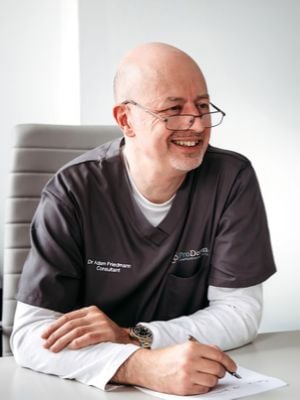
We spoke to Dr Adam Friedmann, MBBS, FRCP, IFAAD, a leading UK consultant dermatologist with over 25 years of experience in dermatology, to get his expert perspective on collagen supplementation, the importance of clinical evidence and what really matters when choosing a product.
A graduate of King's College London, Dr Friedmann trained at leading London teaching hospitals and is the Founding Director and Clinical Lead of ProDerm UK. He is a Fellow of the Royal College of Physicians and an International Fellow of the American Academy of Dermatology.
Drawing on his extensive clinical experience and specialist knowledge of skin health, Dr Friedmann answers some of the most common questions about collagen supplements.
What is collagen, and why is it important for our skin?
Collagen is one of the key structural proteins in our skin, helping to maintain its firmness and elasticity.
As we age, our skin's collagen gradually declines, with changes beginning from around our twenties and thirties. This contributes to some of the visible signs of skin ageing, including fine lines, wrinkles and loss of firmness.
If your goal is to maintain firmer-looking skin as you age, I believe collagen supplementation is worth considering as part of a broader approach to skin health.
As a consultant dermatologist, what do you look for in a collagen supplement?
The first thing I look for is scientific evidence. As a dermatologist, I want to understand the research behind a product and whether there is reliable clinical evidence to support the effects it claims to have.
Not all collagen supplements are the same. It is important to consider the specific collagen peptides used, the quality of the research and whether the ingredients have been evaluated in well-designed clinical studies.
I also look for something that is easy to take consistently. A supplement that can be added to food or a drink is easier to incorporate into a daily routine.
How does oral collagen supplementation work?
There is a common misconception that collagen cannot have an effect when taken orally because it is broken down during digestion.
However, research into hydrolysed collagen has shown that digestion can release smaller peptides, some of which can be absorbed into the bloodstream.
These bioactive peptides have been investigated for their potential influence on processes within the skin, including collagen production.
Clinical studies have also examined the effects of oral collagen supplementation on skin elasticity, hydration and wrinkle depth. This is why I believe it is important to look at the scientific evidence behind the specific collagen peptides used in a supplement.
Can collagen supplements improve the appearance of your skin?
Research into collagen supplementation has examined several aspects of skin appearance, including firmness, hydration, elasticity and wrinkle depth.
Some clinical studies have reported improvements in these measures, although results can vary depending on the formulation, dosage and duration of supplementation.
For me, the important point is to distinguish between general claims about collagen and evidence relating to specific, clinically studied collagen peptides.
Why is clinical research so important when choosing a collagen supplement?
As a dermatologist, I believe it is important to look beyond marketing claims and examine the quality of the scientific research.
Ideally, I want to see well-designed, placebo-controlled clinical studies that measure meaningful outcomes, rather than relying solely on consumer testimonials.
It is also important to understand that not all collagen supplements contain the same peptides. Research involving one formulation does not automatically demonstrate that every collagen product will deliver the same results.
How important is it for a collagen supplement to be easy to take?
Convenience is very important. A supplement should be easy to incorporate into everyday life, particularly when consistency is needed over several weeks or months.
One of the things I like about The Solution™ Beauty Collagen by Oslo Skin Lab is that it comes in individual sachets that can be added to food or drinks.
It is tasteless and odourless, making it simple to take once a day without significantly changing your usual routine.
How long does it take to see results from collagen supplementation?
Clinical research involving the collagen peptides used in The Solution™ Beauty Collagen has reported results from as early as eight weeks, including improvements in measures of skin firmness and hydration and reductions in the appearance of wrinkles.
However, results vary between individuals, and consistency is important when assessing the effects of any supplement.
As a dermatologist, what makes The Solution™ Beauty Collagen by Oslo Skin Lab stand out to you?
My preferred collagen supplement is The Solution™ Beauty Collagen by Oslo Skin Lab.
For me, the most important consideration is the scientific evidence behind the collagen peptides used in a product.
The Solution™ contains hydrolysed collagen peptides and is designed to be taken daily. It comes in convenient sachets that can be mixed into a drink or added to food.
That combination of research into its collagen peptides and everyday convenience is why it is my collagen supplement of choice.
About Dr Adam Friedmann, MBBS, FRCP, IFAAD
 |
|
|
Learn more about Dr Adam Friedmann: ProDerm UK
Explore related articles:
→ Collagen vs cellulite: what you need to know to take care of your skin
→ Everything you need to know about collagen
About Dr Adam Friedmann, MBBS, FRCP, IFAAD
|
|
|
Learn more about Dr Adam Friedmann: ProDerm UK
Explore related articles:
→ Collagen vs cellulite: what you need to know to take care of your skin
→ Everything you need to know about collagen
About Dr Adam Friedmann, MBBS, FRCP, IFAAD
Consultant Dermatologist | Founding Director and Clinical Lead, ProDerm UK
|
Dr Adam Friedmann is an experienced UK consultant dermatologist with over 25 years of experience in dermatology. |
Learn more about Dr Adam Friedmann: ProDerm UK
Explore related articles:
→ Collagen vs cellulite: what you need to know to take care of your skin
→ Everything you need to know about collagen